Every sale posts itself
An order writes a balanced journal entry against your chart of accounts, and a refund writes its own. The ledger is built by service, not re-keyed from a spreadsheet weeks later.

Restaurant accounting software for Egypt
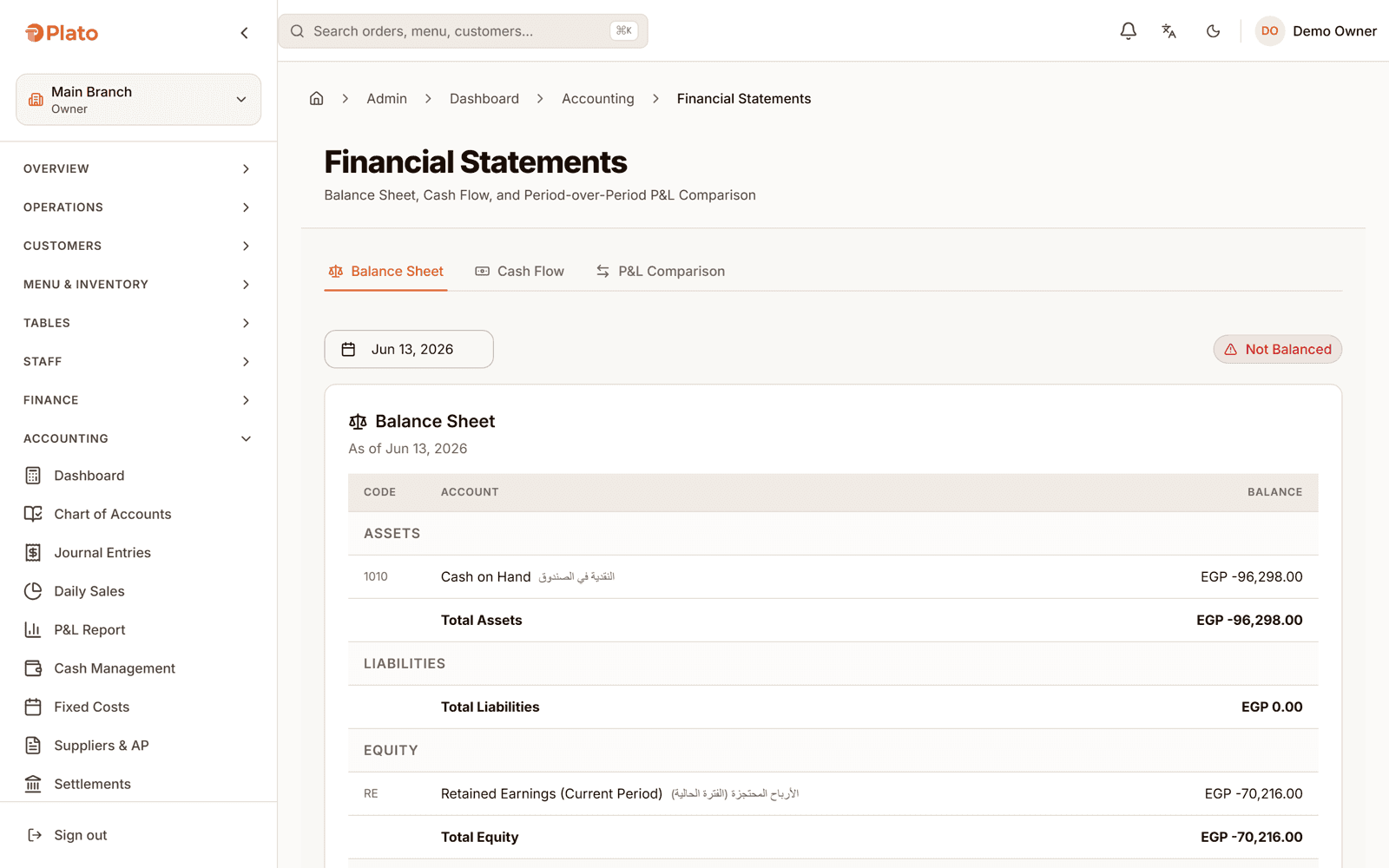
Plato posts a balanced journal entry for every sale and refund, reconciles what the gateway actually paid you, and consolidates every branch into one P&L. Real double entry — not a sales report with a total at the bottom.
What Plato accounting does
Plato is the accounting layer of a restaurant operating system built for Egypt. Every order and refund posts a balanced journal entry against a real chart of accounts. Statements, settlements, cash shifts, tax periods and multi-branch consolidation all read from those same entries — so month-end is a review, not a reconstruction.
From the order to the ledger
Restaurant accounting usually fails in the gap between the till and the ledger. Plato closes that gap by writing the entry where the money moved.
An order writes a balanced journal entry against your chart of accounts, and a refund writes its own. The ledger is built by service, not re-keyed from a spreadsheet weeks later.
An entry whose debits and credits do not match is rejected outright, and a single line cannot carry both. The system will not hold a book that does not balance.
Voiding posts a reversing entry with the debits and credits swapped. The original stays on the record, so the history survives the correction.
Consolidated P&L, branch comparison and ranking, inter-branch transfers and HQ cost allocation — one set of books across many kitchens.
| Account | Debit | Credit |
|---|---|---|
| Cash | 480.00 | — |
| Sales revenue | — | 429.00 |
| VAT payable | — | 51.00 |
| Total | 480.00 | 480.00 |
Debits equal credits, so the entry posts.
Balanced at the point of entry
Debits and credits are totalled and compared as the entry is written. If they disagree, the entry is refused with both totals named. That single rule is the difference between a ledger and a list of transactions.
Against the month-end scramble
Most restaurants do get accounts eventually. The question is how much of the year they spend not knowing.
| Capability | Sales export to a bookkeeper | Plato |
|---|---|---|
| Entries | Typed up weeks later | Posted with the order that created them |
| Balance | Discovered at review | Refused at the point of entry |
| Corrections | Rows edited or deleted | Reversing entries, original preserved |
| Settlements | Bank total against a guess | Expected against received, reconciled |
| Branches | Consolidated by hand | Consolidated P&L, comparison and ranking |
| Period close | Whenever the file is finished | Closed and locked with a date |
Fitted to who keeps your books
See the P&L without waiting for anyone. The statements read from entries that service already wrote, so the number is current by definition.
Work in a real chart of accounts with journal entries, an account ledger, fiscal periods and exports — instead of rebuilding a restaurant from receipts.
Consolidate branches into one P&L, rank them against each other, move stock and cost between them, and allocate head-office cost deliberately.
Getting your books on
You are not migrating years of history on day one. You are pointing today's service at a chart of accounts.
Begin with a restaurant chart of accounts and adjust it, rather than designing one from an empty screen.
Orders and refunds write their own entries as service runs, against the accounts you just set.
Match what the gateway settled against what was expected, and resolve the difference deliberately.
Close and lock the period when it is done, so the numbers behind a filed month cannot drift.
Restaurant accounting questions
Real double entry. Each entry is made of debit and credit lines against a chart of accounts, the two sides are totalled and compared before the entry is accepted, and an unbalanced entry is rejected with both totals named.
Posting is automatic. Closing an order writes its journal entry, and a refund writes its own reversing-side entry, so the ledger is built by service rather than typed up afterwards.
Voiding an entry posts a reversing entry with the debits and credits swapped, leaving the original in place. Corrections are additive, so the audit trail survives them.
Yes. Plato records what was expected from a settlement against what actually arrived, reconciles the two, and lets the remainder be written off as a decision rather than a silent gap.
Yes. Branches roll up into a consolidated P&L, can be compared and ranked against each other, and support inter-branch transfers and head-office cost allocation.
Plato keeps the ledger, produces the statements and exports the data. Your accountant reviews, advises and files from books that are already current, instead of rebuilding them from receipts first.
See it on your own numbers
Book a walkthrough with your branches, your payment channels and the accounts you actually report on.
Send us a few details. We'll set up a live walkthrough on your real menu, in your language, within one business day.