Every channel on the same board
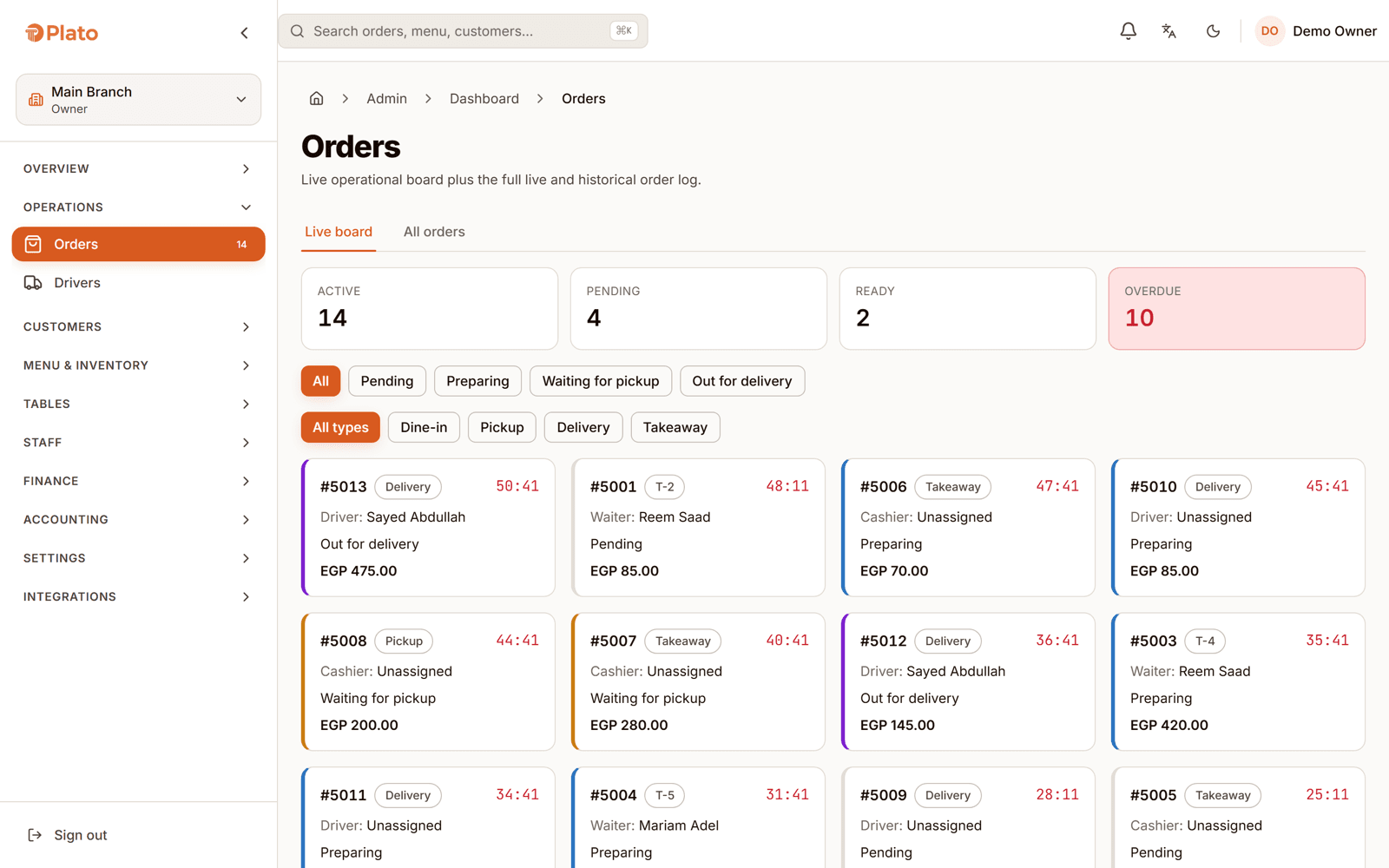
Dine-in, takeaway and delivery orders live in one live view for the branch, each tagged with the channel it arrived on, so nobody reconciles three screens during a rush.

Restaurant order management
Dine-in, takeaway and delivery arrive on the same live orders board. Each order carries the channel it came from, the status it is in, and a record of every change made to it.
What the orders board is
In Plato an order is created, fired to the kitchen, served and closed — and it carries its channel with it the whole way. Dine-in, takeaway and delivery differ in how they arrive and how they leave, not in how they are tracked, so the floor reads one board instead of three screens.
From intake to close
Orders go wrong in the handovers — the till to the kitchen, the kitchen to the floor, the floor to the driver. Each handover is a status somebody has to own.
Dine-in, takeaway and delivery orders live in one live view for the branch, each tagged with the channel it arrived on, so nobody reconciles three screens during a rush.
Created, fired, served, cancelled. Each transition is an explicit action against the order rather than a note someone shouts across the pass.
Order events are recorded, and voids carry a reason. When a cheque is disputed at the end of the night, the history answers instead of the loudest person.
An order placed for later is held and fired at the right time by a scheduled job, so a pre-order for 8pm does not depend on someone remembering at 7:45.
Each step is stamped and attributed, so a disputed order has an answer.
The order's own history
An order records when it was created, when it was fired to the kitchen and when it was served, alongside the channel it came from and the events that changed it. That history is what makes a disputed order answerable.
Against a screen per channel
Most restaurants add a channel by adding a device. It works until two of them disagree about the same order.
| Capability | A device per channel | Plato |
|---|---|---|
| Intake | One screen per channel | One board, channel tagged per order |
| Status | Different words on each device | The same four steps everywhere |
| Kitchen | Re-keyed by hand | Fired straight from the order |
| Disputes | Whoever remembers loudest | Order events and void reasons |
| Pre-orders | A note and a hope | Held and fired on schedule |
| Reporting | Combined afterwards | One set of orders to read |
Fitted to how orders arrive
Orders open against a table and move through the same statuses as everything else, so the floor and the kitchen read one queue.
Fast intake, a visible queue, and a clean close — without a separate system for walk-ups.
Delivery orders carry their channel to dispatch, so the trip is attached to the order rather than tracked on paper.
Getting on one board
The board is fed by the till you already use. Most of the setup is deciding what a channel means for your branch.
Set up the channels the branch actually sells through, with their own pricing and charge policy if they differ.
Orders created at the till carry their channel from the first tap.
Move orders through fired and served so the kitchen and the floor share one status.
Use order events and void reasons when a night needs explaining.
Order management questions
Yes. Orders for the branch appear on one live board regardless of channel, and each order carries the channel it arrived on so you can still read them apart.
An order is created, fired to the kitchen, then served, and it can be cancelled. Each transition is an explicit action rather than an assumption.
Order events are recorded as the order moves, so changes have a trail. Voids carry a reason, which is what makes end-of-night disputes resolvable.
Yes. A scheduled order is held and fired at the right moment by a background job, rather than relying on someone watching the clock.
Yes. Pricing and charge policy can be set per channel, so a delivery price can differ from the dine-in price without a second menu.
No. A channel can be paused for one branch and resumed later, so a location can stop delivery for the night without affecting the rest of the group.
See it on your own service
Book a walkthrough with your channels, your busiest hour and the handover that currently goes wrong.
Send us a few details. We'll set up a live walkthrough on your real menu, in your language, within one business day.